
Task Teacher Guide
Be sure to read the teacher guide prior to running the task. When you’re ready to run the task, use the tabs at the top of the page to navigate through the lesson.
Through This Assessment Opportunity…
Students will demonstrate the concepts and skills that they have developed through this context and learning experience.
Intentionality…
The purpose of this assessment is for students to demonstrate their understanding of the following big ideas.
Number:
- Multiplication and division are related.
- There are two types of division.
- Partitive division reveals a rate.
- Quotative (or measured) division reveals the numbers of parts when the rate is known.
- The dividend from any division sentence can be decomposed into smaller parts to allow for friendlier division by the divisor. This strategy is known as partial quotients. (i.e.: 85 ÷ 5 = 45 ÷ 5 + 40 ÷ 5 = 9 + 8 = 17)
- Percents and fractions are related.
- A percent of a quantity can be found through partitioning.
- Multiplying by a percent is the same as multiplying by an equivalent fraction.
The independent assessment will allow students to demonstrate concepts and skills related to the following learning goals:
- I will solve division problems using an appropriate model to communicate my thinking.
- I will develop a plan to solve multi-step problems involving division and percent.
- I will determine the percent of a whole number quantity.
- I will interpret division models.
- I will notice and name partitive and quotative division.
- I will communicate division contexts that are quotative and contexts that are partitive.
Students might write and/or model their answers independently. Students can also be interviewed by their teacher.
An alternative assessment opportunity should be offered if this tool will not successfully capture what the student knows, understands or can do.
Math Talk
Related String of Problems
In today’s math talk, students will use an appropriate model to solve the following division sentences. Encourage students to develop a context and name the type of division that they are modelling. The different sentences below lend themselves to a variety of strategies. Highlight student strategies as they share their thinking on a number line.
Are they using repeated addition, repeated subtraction, using partial products, halving? How do they determine their strategy? Do they demonstrate flexibility based on the numbers?
96 ÷ 4
192 ÷ 8
180 ÷ 15
253 ÷ 11
Consider viewing the following silent solution animation video to help you better understand how you might represent student thinking on a number line as well as to understand what is really going on when students are using partial quotients – especially how different this strategy looks like when the type of division is partitive vs. quotative.
Assessment
Assessment Considerations…
Students will have an opportunity to independently complete the following assessment. As you are reviewing the student responses, consider how the student went about solving.
Are they:
- Using concrete materials to fair share?
- Using a concrete or visual array?
- Using repeated addition or skip counting?
- Using partial products?
- Using repeated subtraction?
- Using an open array?
- Using a flexible algorithm?
- Partitioning a number line?
If the student’s strategy is unclear based on the product submitted, you might consider following up with a conversation. Understanding the student’s cognitive process will help you understand where the student is along their learning trajectory. This information will be critical in determining the appropriate next steps.
Assessment: Dividing whole numbers through partitive and quotative division and finding a percent of a whole number
Question #1:
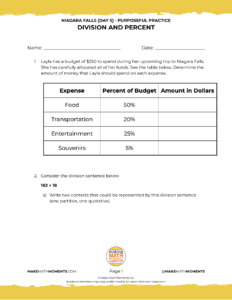
Layla has a budget of $250 to spend during her upcoming trip to Niagara Falls. She has carefully allocated all of her funds. See the table below. Determine the amount of money that Layla should spend on each expense.
Question #2:
Consider the division sentence below.
162 ÷ 18
- Write two contexts that could be represented by this division sentence (one partitive, one quotative).
- Use a model to represent and solve both contexts.
Question #3:
Consider the model below.
96 ÷ 6
- Write a division sentence that could be represented by this model.
- Write a multiplication sentence that could be represented by this model.
- Write a division context that could be represented by this model.
- Is your context partitive or quotative? How do you know?
Question #4:
Mr. Drury has planned a visit to Zombie Attack with his grade seven class during their upcoming trip to Niagara Falls. The total cost of admission for all students is $240. If the admission is $8.00/student, how many students are in Mr. Drury’s class?
Question #5:
My grandfather James purchased admission to Ripley’s Odditorium for himself and 8 friends. Because they are seniors, they are able to purchase their tickets at a discounted price. Use a model of your choice to help you answer the following:
- If the total cost for 9 tickets is $162, how much did they pay per ticket?
- If the regular ticket price is $20, how much of a discount did they receive?
Considerations to Promote Student Growth
Based on the student thinking demonstrated on this assessment, provide students with descriptive feedback – written, verbal, or both – which includes next steps students should take in order to promote extending what they know, understand and can do.
Since assessment should be an opportunity for students to learn and for the teacher to understand where a student is in their learning journey, this should not close the door on these big ideas, models, and strategies.
What opportunities can you provide students with to demonstrate any further learning they engage in after this assessment day?
We suggest collecting this reflection as an additional opportunity to engage in the formative assessment process to inform next steps for individual students as well as how the whole class will proceed.
Download Editable/Printable Handout
You might choose to simply open the document to display via your projector/TV, make a copy for editing, download as a PDF or upload to your LMS and/or print for students to have a physical copy.
Resources and Downloads
Download a printable lesson plan, video/images, and presentation slides in Keynote and PowerPoint format to make the experience as smooth as possible here.
Lesson Tip Sheet

Download the lesson plan in PDF format so you can keep it handy and share with colleagues.
Videos & Images

Download the videos, images, and related media files to your computer to avoid streaming.
Keynote Slides

Download in Apple Keynote format to avoid streaming video and run the lesson smoothly.
PowerPoint Slides

Download in Microsoft PowerPoint format to avoid streaming video and run the lesson smoothly.
Printable Handout
Download/edit the handout so you can keep it handy and share with colleagues.
Explore The Entire Unit of Study
This Make Math Moments Task was designed to spark curiosity for a multi-day unit of study with built in purposeful practice, and extensions to elicit and emerge mathematical models and strategies.
Click the links at the top of this task to head to the other related lessons created for this unit of study.
Problem 1
96 ÷ 4
Problem 2
192 ÷ 8
Problem 3
180 ÷ 15
Problem 4
253 ÷ 11
1. Layla has a…
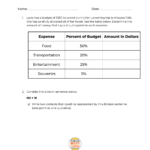
Layla has a budget of $250 to spend during her upcoming trip to Niagara Falls. She has carefully allocated all of her funds. See the table below. Determine the amount of money that Layla should spend on each expense.
2. Consider the…
Consider the division sentence below.
162 ÷ 18
- Write two contexts that could be represented by this division sentence (one partitive, one quotative).
- Use a model to represent and solve both contexts.
3. Consider the…
Consider the model below.
- Write a division sentence that could be represented by this model.
- Write a multiplication sentence that could be represented by this model.
- Write a division context that could be represented by this model.
- Is your context partitive or quotative? How do you know?
4. Mr. Drury has planned…
Mr. Drury has planned a visit to Zombie Attack with his grade seven class during their upcoming trip to Niagara Falls. The total cost of admission for all students is $240. If the admission is $8.00/student, how many students are in Mr. Drury’s class?
5. Mr. Drury has planned…
My grandfather James purchased admission to Ripley’s Odditorium for himself and 8 friends. Because they are seniors, they are able to purchase their tickets at a discounted price. Use a model of your choice to help you answer the following:
- If the total cost for 9 tickets is $162, how much did they pay per ticket?
- If the regular ticket price is $20, how much of a discount did they receive?
Download Editable/Printable Handout
You might choose to simply open the document to display via your projector/TV, make a copy for editing, download as a PDF or upload to your LMS and/or print for students to have a physical copy.