
Task Teacher Guide
Be sure to read the teacher guide prior to running the task. When you’re ready to run the task, use the tabs at the top of the page to navigate through the lesson.
[accordion openall="false" clicktoclose="true" state="closed" autoclose="false" openfirst="true" clicktoclose="true"]
[accordion-item title=”In This Purposeful Practice…”]
Students will explore modelling both types of division (partitive and quotative).
[/accordion-item]
[accordion-item title=”Intentionality…”]
The purpose of the Day 2 activities is to reinforce key concepts from Day 1. Students will engage in a string of related problems through a math talk and will have an opportunity to complete independent purposeful practice.
They will also begin investigating finding a percent of a quantity through the relationship between percents, fractions and partitioning. The math talk and purposeful practice serve to develop a deeper understanding of the following big ideas.
- Multiplication and division are related.
- There are two types of division.
- Partitive division reveals a rate.
- Quotative (or measured) division reveals the numbers of parts when the rate is known.
- The dividend from any division sentence can be decomposed into smaller parts to allow for friendlier division by the divisor. This strategy is known as partial quotients. (i.e.: 85 ÷ 5 = 45 ÷ 5 + 40 ÷ 5 = 9 + 8 = 17)
- Percents and fractions are related.
- A percent of a quantity can be found through partitioning.
[/accordion-item]
[/accordion]
Math Talk
[accordion openall=”false” clicktoclose=”true” state=”closed” autoclose=”false” openfirst=”false” clicktoclose=”true”]
[accordion-item title=”Related String of Problems”]
Part 1:
Present the contexts below one at a time. Consider leveraging the context from day 1 in that there are many different tourist attractions in Niagara Falls, Ontario which is why the following contexts arise.
Encourage students to use a mathematical model to represent the situation and solve. If the array is not a model used by any students, find an opportunity to highlight this tool by using it to model the thinking of a student as you highlight their approach and strategy regardless of whether they chose to use the array model to represent their thinking.
$120 was used to purchase 8 tickets. What was the cost of each ticket?
$120 was used to purchase tickets at a cost of $16 per ticket. How many tickets were purchased?
The roller coaster has a maximum capacity of 160 riders. If there are 8 passenger cars, how many passengers does each car hold?
The roller coaster has a maximum capacity of 160 riders. If each passenger car can hold 8 passengers, how many cars are there?
Part 2:
Draw a number line from 0-100. Ask students to plot the following points along the number line where 100 represents the whole.
5 tenths
2 tenths
1 tenth
50 hundredths
50%
10%
60%
6 tenths
55%
55 hundredths
[/accordion-item]
[/accordion]
Purposeful Practice
[accordion openall=”false” clicktoclose=”true” state=”closed” autoclose=”false” openfirst=”false” clicktoclose=”true”]
[accordion-item title=”While Students Are Practicing…”]
Students will have an opportunity to independently complete practice questions related to partitive and quotative division as well as finding a percent of a quantity.
As students are working, you might consider using this opportunity to pose purposeful questions and document student thinking for the purpose of formative assessment.
Pay close attention to the strategies that students are using.
Are students:
- Using concrete materials to fair share?
- Using a concrete or visual array?
- Using an open array?
- Using partial products and/or partial quotients?
- Using a flexible algorithm?
- Partitioning a number line?
While students are working independently, you might also consider strategically pulling students individually or in small groups to offer guided instruction in order to move them along their developmental continuum.
[/accordion-item]
[accordion-item title=”Questions: Partitive & Quotative Division and Finding a Percent of a Quantity”]
Question #1:
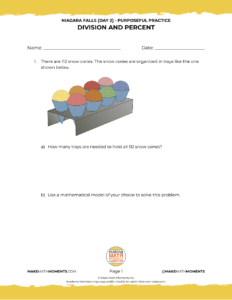
There are 112 snow cones. The snow cones are organized in trays like the one shown below.
How many trays are needed to hold all 112 snow cones?
Use a mathematical model of your choice to solve this problem.
Write a division sentence.
Question #2:
There are 112 snow cones. The snow cones are divided evenly into 8 different trays. Draw the tray below.
Write a division sentence.
Question #3:
Write two different contexts that could be represented by the division sentence below.
96 ÷ 6
Context 1: The number of parts are known.
Context 2: The quantity per one part (the rate) is known.
Question #4:
Three contestants participated in the “High-Striker” carnival game. The purpose for players is to ring the bell suspended on top of the tower.
- If Alexa’s strike reached 10%, or one-tenth of the height of the pole, how many points is she awarded?
- If Jin’s strike reached 50% or five-tenths of the height of the pole, how many points is he awarded?
We suggest collecting this reflection as an additional opportunity to engage in the formative assessment process to inform next steps for individual students as well as how the whole class will proceed.
Download Editable/Printable Handout
You might choose to simply open the document to display via your projector/TV, make a copy for editing, download as a PDF or upload to your LMS and/or print for students to have a physical copy.
[/accordion-item]
[/accordion]
Resources and Downloads
Download a printable lesson plan, video/images, and presentation slides in Keynote and PowerPoint format to make the experience as smooth as possible here.
Lesson Tip Sheet

Download the lesson plan in PDF format so you can keep it handy and share with colleagues.
Videos & Images

Download the videos, images, and related media files to your computer to avoid streaming.
Keynote Slides

Download in Apple Keynote format to avoid streaming video and run the lesson smoothly.
PowerPoint Slides

Download in Microsoft PowerPoint format to avoid streaming video and run the lesson smoothly.
Printable Handout
Download/edit the handout so you can keep it handy and share with colleagues.
Explore The Entire Unit of Study
This Make Math Moments Task was designed to spark curiosity for a multi-day unit of study with built in purposeful practice, and extensions to elicit and emerge mathematical models and strategies.
Click the links at the top of this task to head to the other related lessons created for this unit of study.
[accordion openall=”false” clicktoclose=”true” state=”closed” autoclose=”false” openfirst=”true” clicktoclose=”true”]
[accordion-item title=”$120 was used to…”]
$120 was used to purchase 8 tickets.
What was the cost of each ticket?
[/accordion-item]
[accordion-item title=”$120 was used to…”]
$120 was used to purchase tickets at a cost of $16 per ticket.
How many tickets were purchased?
[/accordion-item]
[accordion-item title=”The roller coaster…”]
The roller coaster has a maximum capacity of 160 riders.
If there are 8 passenger cars, how many passengers does each car hold?
[/accordion-item]
[accordion-item title=”The roller coaster…”]
The roller coaster has a maximum capacity of 160 riders.
If each passenger car can hold 8 passengers, how many cars are there?
[/accordion-item]
[/accordion]
[accordion openall="false" clicktoclose="true" state="closed" autoclose="false" openfirst="true" clicktoclose="true"]
[accordion-item title=”Draw a number line…”]
Draw a number line from 0-100.
Assuming 100 represents the whole, plot the following…
[/accordion-item]
[accordion-item title=”…”]
5 tenths
[/accordion-item]
[accordion-item title=”…”]
2 tenths
[/accordion-item]
[accordion-item title=”…”]
1 tenth
[/accordion-item]
[accordion-item title=”…”]
50 hundredths
[/accordion-item]
[accordion-item title=”…”]
50%
[/accordion-item]
[accordion-item title=”…”]
10%…
[/accordion-item]
[accordion-item title=”…”]
60%
[/accordion-item]
[accordion-item title=”…”]
6 tenths
[/accordion-item]
[accordion-item title=”…”]
55%
[/accordion-item]
[accordion-item title=”…”]
55 hundredths
[/accordion-item]
[/accordion]
[accordion openall="false" clicktoclose="true" state="closed" autoclose="false" openfirst="true" clicktoclose="true"]
[accordion-item title=”1. There are 112…”]
There are 112 snow cones. The snow cones are organized in trays like the one shown below.
How many trays are needed to hold all 112 snow cones?
Use a mathematical model of your choice to solve this problem.
Write a division sentence.
[/accordion-item]
[accordion-item title=”2. There are 112…”]
There are 112 snow cones. The snow cones are divided evenly into 8 different trays.
Draw the tray below.
Write a division sentence.
[/accordion-item]
[accordion-item title=”3. Write two different…”]
Write two different contexts that could be represented by the division sentence below.
96 ÷ 6
Context 1: The number of parts are known.
Context 2: The quantity per one part (the rate) is known.
[/accordion-item]
[accordion-item title=”4. Three contestants…”]
Three contestants participated in the “High-Striker” carnival game. The purpose for players is to ring the bell suspended on top of the tower.
- If Alexa’s strike reached 10%, or one-tenth of the height of the pole, how many points is she awarded?
- If Jin’s strike reached 50% or five-tenths of the height of the pole, how many points is he awarded?
[/accordion-item]
[/accordion]
Download Editable/Printable Handout
You might choose to simply open the document to display via your projector/TV, make a copy for editing, download as a PDF or upload to your LMS and/or print for students to have a physical copy.